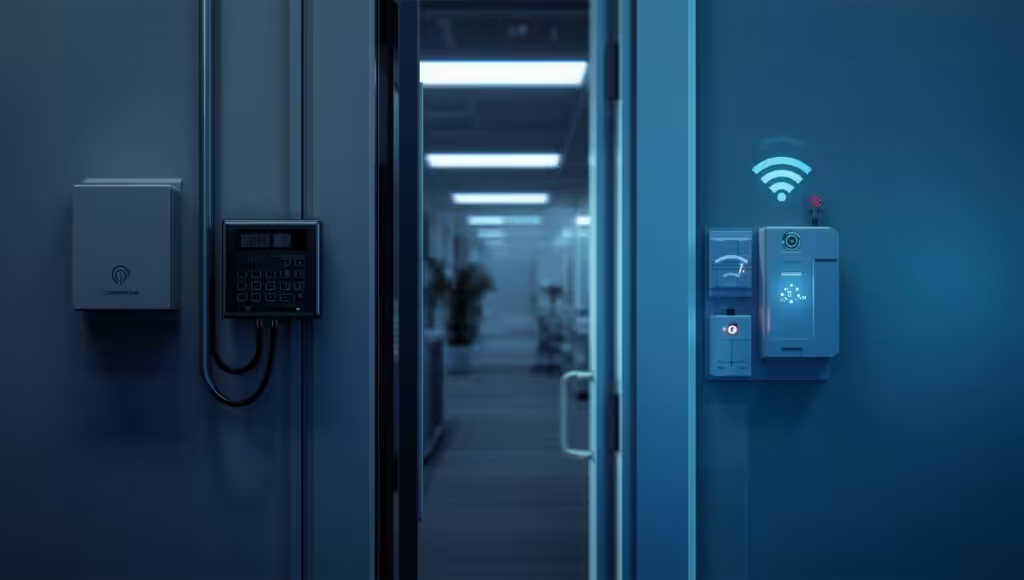
Protecting your business premises is about more than just locking the front door at five o’clock. It requires a comprehensive approach to security that deters potential criminals and alerts you the moment something goes wrong. For many business owners and facilities managers, the foundation of this protection is a reliable intruder alarm system.
When you begin researching alarm systems, one of the first and most significant choices you face is whether to install a wired or a wireless system. Both technologies have evolved significantly over the years, and both offer robust protection when installed correctly. However, they operate in fundamentally different ways and are often better suited to different types of environments.
Making the right choice depends on the specific needs of your building, your budget, and your long-term plans for the site. This guide explores the key differences between wired and wireless intruder alarms to help you determine which option aligns best with your business security requirements.
Understanding Intruder Alarm Systems
Before comparing the two main types of infrastructure, it is helpful to understand the core function of an intruder alarm. Regardless of how the components connect, the primary goal remains the same: to detect unauthorised entry and trigger a response.
A standard system comprises a control panel (the brain of the system), a keypad for arming and disarming, and various sensors. These sensors might include magnetic door contacts, motion detectors (PIRs), and vibration sensors on windows. When a sensor is triggered while the system is armed, it sends a signal to the control panel, which then activates sirens and, if monitored, alerts a dedicated receiving centre or the police.
For commercial sites, the reliability of this communication path is critical. Whether that signal travels through physical cables or radio waves is the defining difference between wired and wireless solutions.
Wired Intruder Alarms Explained
Wired intruder alarms are the traditional choice for commercial security. In this setup, every sensor, keypad, and siren is physically connected to the central control panel via cabling. These cables usually run through walls, ceilings, or trunking to keep them hidden and protected from tampering.
Because these systems rely on a physical connection, they are renowned for their stability. They draw power directly from the mains electricity supply (supported by a backup battery in the control panel), meaning you do not need to worry about changing batteries in individual sensors.
Wired systems are frequently found in new builds or during major renovations, where cables can be installed before the walls are plastered. They are also common in large industrial sites where the distance between sensors might be too great for a wireless signal to travel reliably without repeaters.
Wireless Intruder Alarms Explained
Wireless intruder alarms have gained significant traction in the commercial sector over the last decade due to advancements in battery life and signal encryption. Instead of using cables, the sensors communicate with the control panel using radio frequencies.
Modern wireless systems are far more sophisticated than the early models that were prone to interference. Today, they use secure, two-way communication frequencies that check in with the control panel regularly to ensure the sensors are active and functioning.
The biggest advantage of a wireless system is the ease of installation. Since there is no need to run cables from the panel to every single detector, the physical work required on-site is drastically reduced. This makes wireless intruder alarms for businesses an attractive option for listed buildings, finished offices with glass partitions, or sites where drilling into walls is restricted or aesthetically undesirable.
Key Differences Between Wired and Wireless Alarms
To help you decide which route is best for your premises, it is useful to compare the systems across several practical categories.
Installation Requirements
Wired systems require a more invasive installation process. Engineers need to route cables throughout the building, which may involve lifting floorboards or drilling through masonry. This takes time and can cause disruption to daily operations.
Wireless systems are much faster to install. A professional engineer can often fit a comprehensive system in a fraction of the time it takes to wire a building. There is minimal dust, noise, or need to make good on decor after the work is finished.
Reliability and Interference
Wired systems are generally considered the gold standard for reliability because physical wires are not susceptible to radio frequency interference. They provide a constant, uninterrupted connection.
Wireless systems, while highly reliable today, can theoretically be affected by severe interference or physical obstacles like thick reinforced concrete walls or large metal structures. However, professional-grade commercial alarm systems use specific frequencies to minimise this risk.
Maintenance and Power
Wired systems are lower maintenance regarding power. You generally only need to worry about the main backup battery in the control panel, which is checked during annual servicing.
Wireless systems run on batteries located in each sensor. While these batteries can last for several years, they will eventually need replacing. If you have a large site with fifty sensors, managing battery replacements becomes a necessary part of your maintenance schedule.
Scalability and Flexibility
Wireless systems offer superior flexibility. If you reconfigure your office layout or move a temporary partition, moving a wireless motion detector is a simple task. Adding new sensors to extend the system is also straightforward.
Expanding a wired system is more complex. If you build an extension or want to add a sensor in a location where no cable exists, you have to run new cabling back to the control panel, which can be difficult in a finished building.
Which Option Works Better for Different Business Sites
The “best” system is entirely dependent on the nature of your property. Here are a few common scenarios.
Large Industrial Warehouses and Factories
For sprawling industrial sites, wired intruder alarms are often the preferred choice. The distances involved can sometimes stretch the range of wireless signals, and the heavy machinery or metal racking found in these environments can cause signal interference. Additionally, the aesthetic impact of trunking and cabling is rarely an issue in a warehouse setting.
Modern Offices and Retail Units
For high-end retail stores or modern offices with glass walls and suspended ceilings, wireless systems shine. The installation is clean and tidy, preserving the look of the interior. If the business is in a leased unit, wireless systems are also advantageous because they can be removed and taken to new premises with relative ease when the lease ends.
Heritage and Listed Buildings
In Scotland, where many businesses operate from historic stone buildings, wireless is often the only viable option. Drilling into historic fabric to run cables is often prohibited or practically difficult due to the thickness of the stone. A wireless installation respects the building’s integrity while providing modern security standards.
New Construction Projects
If you are building a new commercial premises from the ground up, installing a wired system during the “first fix” stage (before plastering) is usually the most cost-effective and robust solution. The cables can be hidden completely within the fabric of the building, offering a permanent and secure infrastructure.
The Importance of Professional Design and Installation
Whether you choose a wired or wireless solution, the effectiveness of the system relies heavily on the quality of the design and installation. A poorly positioned sensor or an incorrectly programmed control panel can leave your business vulnerable, regardless of the technology used.
For business security systems in Scotland, working with an NSI GOLD-accredited provider ensures that your system meets the highest industry standards. Professional installers assess the specific risks associated with your site, identifying entry points and blind spots that an off-the-shelf kit would likely miss.
Furthermore, professional installation is often a requirement for business insurance policies. Insurers need to know that the system has been installed by a competent company and is maintained correctly. This gives you peace of mind that your intruder alarm will perform exactly as expected should a break-in attempt occur.
Making the Right Security Choice
Choosing between wired and wireless intruder alarms involves balancing installation convenience against long-term maintenance and site-specific constraints. Wired systems offer a “fit and forget” reliability that suits permanent, industrial, or new-build environments perfectly. Wireless systems offer flexibility and speed of installation that is ideal for offices, retail spaces, and historic buildings.
Ultimately, there is no single right answer for every business. The most effective approach is to have a professional survey your site. They can look at the construction of your building, understand your operational needs, and recommend a solution that keeps your assets secure.
If you are currently reviewing your security measures or planning a move to new premises, getting expert advice is the next logical step.
For a professional assessment of your site and guidance on the best security solutions for your business, visit Procom Group.